

Do you want to introduce the Alphabet to your child in a unique way? Though it is essential to teach them their ABC early, teaching them about emotions is equally important. So why not do it together?

Photo Credit: Mayumi.rn
Emotion Alphabet teaches children about different emotions through pictures. Each letter is assigned a feeling, such as “H” for happiness and “S” for sadness. Each emotion is represented by a photo or illustration, allowing children to identify each emotion visually.

Here are the benefits of using Emotion Alphabet
1. Help children identify and recall different emotion
This tool is particularly useful in helping children learn about their emotions because it provides a clear visual representation of each emotion. Visual aids allow children to understand and remember information better than text alone. By associating each emotion with a picture, children can quickly identify and recall the various feelings. Additionally, the illustrations are designed to be visually appealing and engaging to children, making the learning process enjoyable.
2. Provide simple and fun way to communicate their feelings
The Emotion Alphabet provides children with a vocabulary for expressing their emotions. This is particularly helpful for children who may struggle with identifying and articulating their feelings. By associating each emotion with a letter of the alphabet, the Emotion Alphabet provides a simple and intuitive way for children to communicate their feelings. This is especially important as it allows children to express their emotions and seek support when needed.
3. The Emotion Alphabet helps develop their emotional intelligence.
Emotional intelligence refers to the ability to recognize, understand, and manage one’s feelings, as well as the ability to identify and understand the emotions of others.
Emotional intelligence is a crucial skill that plays a significant role in children’s overall development and well-being, as it helps them understand social interactions and build positive relationships with others. By providing children with a vocabulary and visual representation of emotions, the Emotion Alphabet helps them develop this vital skill.
The Emotion Alphabet promotes self-awareness. Self-awareness is the beginning of Emotional Intelligence. Through visual representations, children are encouraged to identify and label their feelings, fostering a greater sense of self-awareness. By becoming more aware of their emotions, children can better regulate them, leading to improved emotional self-control. This, in turn, enhances children’s ability to cope with stress and navigate challenging situations.
4. Emotion Alphabet fosters open communication about emotions between children and adults.
By learning and using the emotion vocabulary provided by the Emotion Alphabet, children are empowered to express their feelings. This enables parents, teachers, and caregivers to provide appropriate support and guidance when children are experiencing strong emotions.
This also serves as a prompt for children to start a conversation about different emotions. A few weeks ago, our eight-year-old child all-of-a-sudden asked about what it means to be ’zealous’ after looking at the Alphabet chart. That question led to a conversation about being zealous and the difference between excited and zealous. Simple Socio-Emotional tools like this can make our lives as Parents and teachers easier.
Start your child’s socio-emotional learning journey with My Emotion Alphabet Chart by Emosyon Bibo. The more vocabulary words your children have regarding emotions, the more likely they will use them to express their feelings.
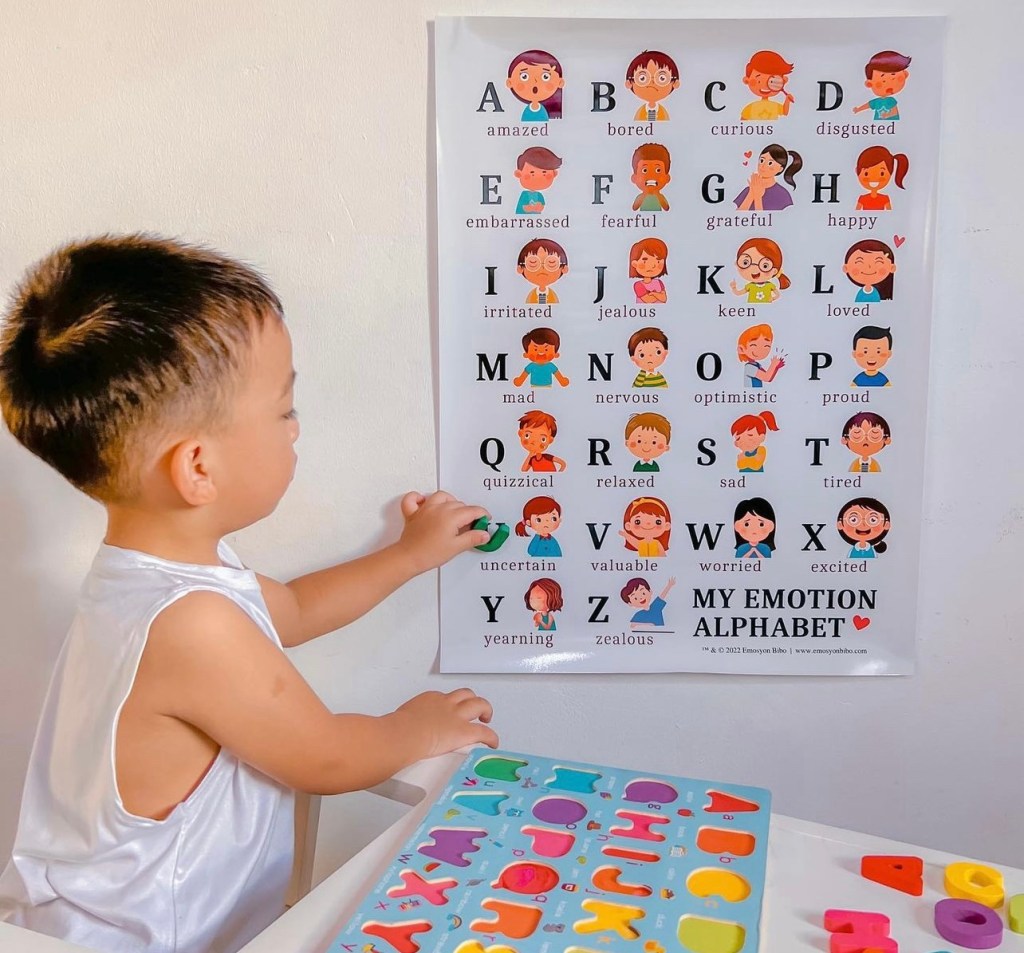
My Emotion Alphabet Chart
Photo Credit: Mayumi.rn IG
This beautifully designed poster depicts 26 feelings (A-Z) through word and picture descriptions. This emotion alphabet can help children generate a variety of words relating to the different emotions they experience
Also check out Emosyon Bibo ’How am I Feeling? | Emotion Cards to supplement this chart.

 Emosyon Bibo®: Socio-Emotional Learning (SEL) Tools Provider