
How do you ”disarm” your children when they are angry, extremely sad, disappointed, or even scared? Do you use logic and tell them to” stop feeling that way? It’s not a big deal”? Or do you empathize and try to feel and understand what they are feeling?
As a working, busy mom, I tend to brush off my children’s unpleasant emotions quickly. It is easier and faster to use logic and dismiss my children’s difficult feelings. The big things to them are small, silly, nonsensical matters to me, so I brush them as if they are not important. What I realized throughout the years, though, is that using logic doesn’t save me time; it actually aggravates the situation. It makes my child more upset and whiny because they don’t get the main core thing they need.
When they have difficult emotions, they need me to recognize their experience, and they need me to listen to them and be there for them during this difficult situation. Remind ourselves that as adults, we have more power and resources to recognize and lower our egos to parent from a calm place. We need strategies to help our kids when they are going through tough times.
Here are three strategies that can help parents to deal with kids difficult emotions. Adapted from the book: The Whole-brain Child by Dr. Daniel J. Siegel
- Connect & Redirect
Make sure to listen, connect, and empathize with your child’s emotions, no matter how nonsensical and frustrating. When our children are feeling a lot, their right brains are dominant. The right brain is responsible for emotions, while the left brain is responsible for logic. If we try to reason with them using logic, it is harder for them to process or understand us, but if we use the right brain’s language, which connects to their emotions, it will be easier for them to respond and calm down.
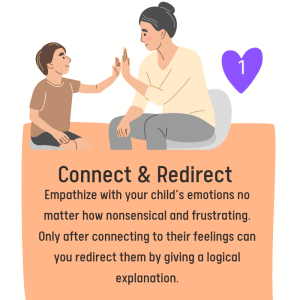
Only after connecting to their feelings (right brain) can you redirect them by giving a logical explanation (left brain).
Self-awareness is also important in this technique. You need to be aware of your emotions when helping your child. If you are getting frustrated, recognize that, take a break, and calm yourself down first before trying again.
2. Name it to tame it.
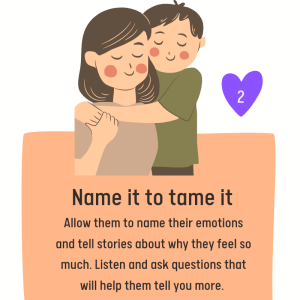
Allow them to name their emotions and tell stories about why they feel so much. Listen and ask questions to help them tell you more about what happened. Allowing them to tell you stories will help their brain process what happened and will help them calm down.
When we are scared, angry, or going through difficult emotions, a part of our brain called the amygdala is activated and sends signals that cause us to panic. However, when we name our feelings, it can trigger a part of the brain that processes, plans, and solves problems. That is why we need to teach our children emotional vocabulary. Here’s what we can do at home;
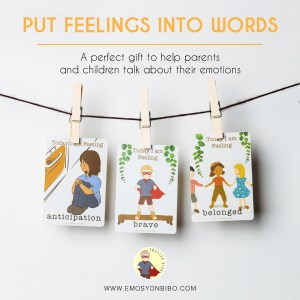
A. If you already have a copy of the Emosyon Bibo’s emotion cards, use them by letting your children choose cards according to how they feel this week. If they can’t read, ask them to look at the picture and pick the one resembling their thoughts. Guide them by showing pictures of the emotions and reading the definition and questions.

B. Be an example first by picking the emotion cards that represent how you feel this week. Read the definition, discuss the synonyms at the back, and answer the questions. Do not rush; give them time to think and respond. Have a conversation and allow them to tell you stories about an emotion they shared.
C. If you don’t have the emotion cards, get a magazine and cut some photos that represent how you and your child feels this week. Paste it in a bond paper/journal and write the name of the emotions and share it. You can also use storybooks and discuss the feelings of the characters.
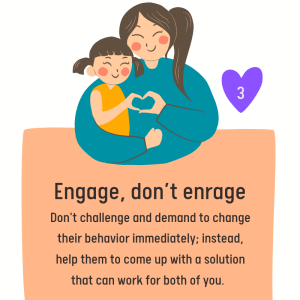
3. Engage, don’t enrage.
Don’t challenge and demand to change their behavior immediately; instead, help them to come up with a solution that can work for both of you. Challenging them directly will leave them feeling more upset. You can say phrases like, “Convince me” or “Come up with a solution that works for both of us” so they can practice problem-solving with you.
They will know that you are trying to understand where they are coming from without compromising the boundaries you set as a parent. When children see us as their allies, they will listen more than resist.
For more inspiration in creating a family culture that promotes emotional connection, visit our Emosyon Bibo® website and follow our Instagram, Facebook, Twitter, and TikTok.
References:
Lieberman, M., Eisenberger, N., Crockett, M., Tom, S., Pfeifer, J., & Way, B. (2007). Putting feelings into words: Affect labeling disrupts amygdala activity in response to affective stimuli. University of California.
Siegel D. J., & Bryson T. P. (2011). The Whole-brain Child, Delacorte Press, UK

 Emosyon Bibo®: Socio-Emotional Learning (SEL) Tools Provider